Nasikagra Drishti
The eyes are directed downward and inward to the tip of the nose. Gentler than Shambhavi and better suited to beginners, it is the gaze Krishna specifies in the Bhagavad Gita for the seated practitioner.
नासिकाग्र दृष्टि
Nāsikāgra Dṛṣṭi
Meaning of the name
Gaze at the tip of the nose. Called Agochari Mudra — the seal of the imperceptible, since what is looked at is barely visible at all.
How to practise
- 1
Sit with the spine straight and the head level — do not drop the chin.
- 2
Half-close the eyes and direct both toward the tip of the nose.
- 3
You will see a double image resolving into a single point. That is correct.
- 4
Hold for a few seconds only, then close the eyes and rest.
- 5
Build up gradually over weeks; a minute is a long hold.
Benefits
- Steadies the mind and stops the eyes wandering during meditation
- Calms anger and emotional agitation quickly
- Improves concentration with far less strain than Shambhavi
- Awakens awareness of mūlādhāra, the root centre
- Prescribed in the Bhagavad Gita (6.13) as part of the meditation posture
What happens in the nervous system
Convergence of the eyes at a near point is coupled through the oculomotor nerve to pupil constriction and lens accommodation — the near triad, which is itself a parasympathetic response. Holding convergence therefore leans the system gently toward rest, which is a tidy physiological reason for a practice recorded two thousand years before anyone knew the nerve existed.
Related practices
शाम्भवी मुद्रा
Śāmbhavī Mudrā
Shambhavi Mudra
शाम्भवी मुद्रा

Dhyana Mudra
ध्यान मुद्रा
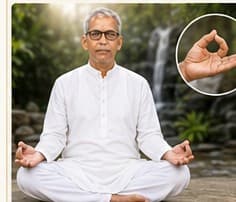
Gyan Mudra
ज्ञान मुद्रा
KSN Murty Yoga Center