Hasta Mudra · हस्त मुद्रा
The hand knows things the mind has forgotten
A mudra is a seal — a circuit closed. Thirty-four of them are documented here, each drawn from a single description of where the fingers go, so that every diagram on this site is the same hand, in the same light, telling you only what changes.
The rule underneath
Five fingers, five elements
Almost everything in this section follows from one idea. Each digit carries an element. Touch a fingertip to the thumb and that element increases; press it into the base of the thumb and it decreases. Once you hold that, you can read any mudra you have never seen before.
Agni · Fire
Thumb
Heat, digestion, metabolism, the will to act. Fire is what converts one thing into another.
Vayu · Air
Index finger
Movement, breath, nerve impulse, thought. Air is everything that will not stay still.
Akasha · Ether
Middle finger
Space, sound, hearing, the room in which everything else happens. The subtlest of the five.
Prithvi · Earth
Ring finger
Bone, muscle, tissue, weight, steadiness. Earth is whatever holds its shape.
Jala · Water
Little finger
Blood, lymph, saliva, tears, lubrication. Water is what flows and what softens.
11 practices
The Five Element Mudras
Eleven gestures built on a single rule: each finger carries an element, touching its tip to the thumb increases that element, and pressing it into the base of the thumb reduces it. Agni and Jala sit alongside Surya and Varuna as companions Guruji teaches separately rather than duplicates.
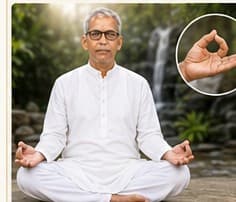
Gyan Mudra
ज्ञान मुद्रा
The most widely practised mudra in all of yoga. The index finger — the individual self — bows to the thumb, the universal. Held during meditation and pranayama, it steadies attention and quietens the surface chatter of the mind.
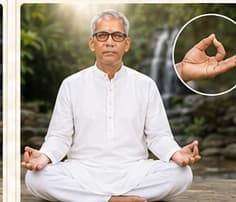
Chin Mudra
चिन् मुद्रा
The same finger position as Gyan Mudra, but with the palms turned downward onto the knees. Turning the palms down grounds and contains the energy instead of drawing it upward — the counterpart, not a variant.
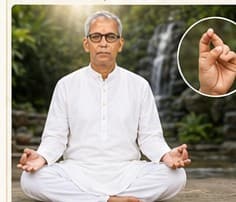
Vayu Mudra
वायु मुद्रा
Where Gyan Mudra raises the air element, Vayu Mudra reduces it. The index finger is folded away and pinned by the thumb — the classical remedy for everything that trembles, rattles, cracks or bloats.
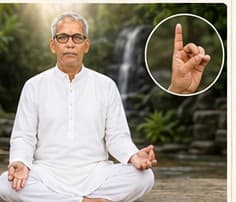
Akash Mudra
आकाश मुद्रा
The middle finger, seat of ether, meets the thumb. Where there is congestion, compression or a sense of being closed in — in the ears, the chest, the heart, the mind — this mudra makes room.
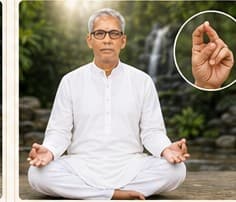
Shunya Mudra
शून्य मुद्रा
The mirror of Akash Mudra: the middle finger is folded to the base of the thumb and held there. This is the classical first-response for earache, and the mudra most reliably reported to give relief within minutes.
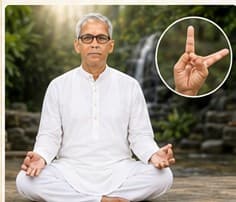
Prithvi Mudra
पृथ्वी मुद्रा
The ring finger, seat of the earth element, meets the thumb. For depletion of every kind — thinness, exhaustion, brittle bones, dull skin, a weak voice, a life that feels precarious.
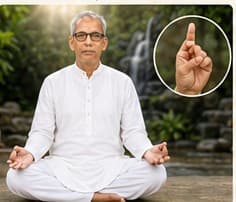
Surya Mudra
सूर्य मुद्रा
The ring finger is folded away and pressed by the thumb: earth down, fire up. This is the mudra of metabolism — of weight, digestion, cold hands, sluggish thyroid and heavy mornings.
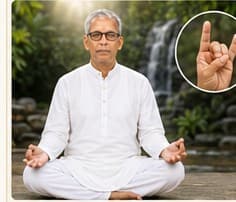
Varun Mudra
वरुण मुद्रा
The little finger, seat of water, meets the thumb. For dryness anywhere in the body — skin, eyes, joints, blood, mouth — and for the emotional brittleness that dryness brings with it.
Jal Shamak Mudra
जल शामक मुद्रा
The little finger is folded to the base of the thumb. Where Varun Mudra moistens, this one dries: for swelling, congestion, watery eyes, excess mucus and fluid that will not move.
Agni Mudra
अग्नि मुद्रा
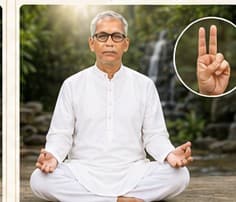
Taught at Tuni alongside Surya Mudra as its close companion rather than its duplicate: where Surya is reached for confidence and weight management, Agni is the one Guruji hands to a student with sluggish digestion or a body that runs cold.
Jala Mudra
जल मुद्रा
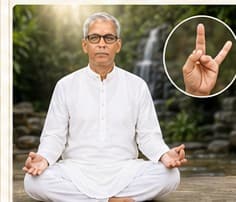
Guruji teaches Jala Mudra as the daily-maintenance practice and Varuna Mudra as the one reached for when dryness has already become a problem — the same element, at two different points on the same dial.
8 practices
Therapeutic Mudras
Combinations aimed at a particular condition — the heart, the gut, the immune system, a specific pain. These are prescribed rather than practised as habit.
Prana Mudra
प्राण मुद्रा
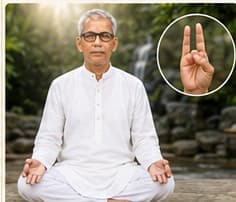
Earth and water together meet fire: the ring and little fingertips both touch the thumb. Called the mudra of vitality, it is the one to reach for when energy has run out and nothing specific is wrong.
Apana Mudra
अपान मुद्रा
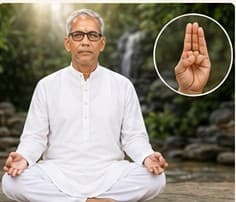
Middle and ring fingertips meet the thumb. This is the mudra of elimination and release: for constipation, for retained urine, for sluggish detoxification, and for anything the body is holding that it should be letting go of.
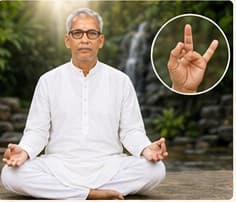
Apana Vayu Mudra
अपान वायु मुद्रा
A combination of Vayu and Apana Mudra. Traditionally taught as a first-aid gesture during cardiac distress, held while help is being called. It should never replace emergency care, but it costs nothing to know.
Kubera Mudra
कुबेर मुद्रा
Index and middle fingertips join the thumb while the ring and little fingers fold into the palm. Three elements gathered, two set aside. Used for focused intention and, very practically, for clearing the sinuses.
Rudra Mudra
रुद्र मुद्रा
Index and ring fingertips both meet the thumb: air and earth held to fire. Directed at the solar plexus, it counters the sinking, dizzy, hollow-in-the-middle feeling of depletion.
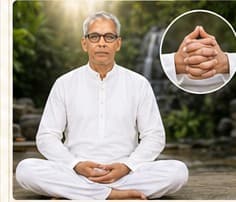
Linga Mudra
लिङ्ग मुद्रा
Interlock the fingers of both hands and raise one thumb straight up, encircled by the other hand. The most warming mudra there is: it raises body heat directly and quickly.
Mukula Mudra
मुकुल मुद्रा
All four fingertips and the thumb are drawn together into a point. All five elements converge, and the hand becomes a nozzle: pressed to a painful place, it concentrates energy where it is wanted.
Vishnu Mudra
विष्णु मुद्रा
The working hand-shape for Nadi Shodhana. The index and middle fingers fold in, leaving the thumb and the ring finger free to close each nostril in turn. Not a mudra held for its own sake, but the tool that makes alternate-nostril breathing possible.
11 practices
Mudras of Meditation & Offering
Gestures held during sitting, chanting and worship. Some are thousands of years old and appear on temple sculpture across the whole of Asia.
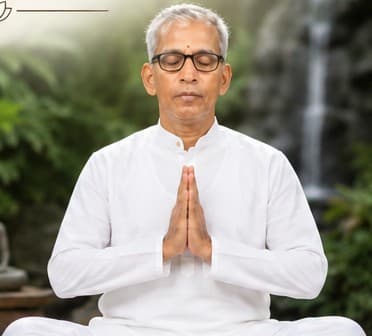
Anjali Mudra
अञ्जलि मुद्रा
Palms joined at the heart. Known to every Indian household as namaskāram, it is also the formal opening and closing of practice: the two halves of the body, the two hemispheres, the two sides of a person brought into one line.
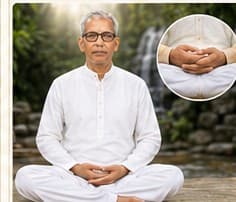
Dhyana Mudra
ध्यान मुद्रा
Both hands rest in the lap, the right on top of the left, thumb tips lightly touching to form an oval. The gesture of the seated Buddha and of every long meditation tradition that followed — because it is the only hand position the body can hold for an hour without noticing it.
Adi Mudra
आदि मुद्रा
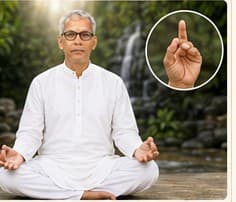
The thumb is placed at the base of the ring finger and the other fingers close over it, making a soft fist. Held during pranayama, it deepens the breath into the upper lobes of the lungs and quietens the nervous system markedly.
Brahma Mudra
ब्रह्म मुद्रा
Both hands make Adi Mudra and press together, knuckles facing, at the level of the navel. The full-body version of the calming effect, and the standard hand position for long pranayama in several classical schools.
Abhaya Mudra
अभय मुद्रा
The right hand is raised to shoulder height, palm facing outward, fingers together and pointing up. Found on almost every ancient Indian image of a teacher or deity, from Gandhara to Amaravati. It is a gesture given to others, and in practice it changes the giver.
Ganesha Mudra
गणेश मुद्रा
The hands hook together in front of the chest and pull apart against each other. Unlike most mudras this one is active and effortful — the only mudra in common use that is fundamentally an exercise, and the classical practice for a heart that feels shut.
Uttarabodhi Mudra
उत्तरबोधि मुद्रा
Fingers interlaced, both index fingers extended and pressed together pointing upward, both thumbs pointing down. A vertical line drawn through the body. Practised for clarity when a decision will not come.
Shankh Mudra
शङ्ख मुद्रा
The left hand is enclosed in the right fist with the left thumb touching the right index finger — the two hands together take the shape of a conch. Held at the sternum during chanting, it steadies and clarifies the voice.
Pushan Mudra
पूषन् मुद्रा
The two hands do different things: the right gathers and receives, the left directs and releases. The mudra of digestion in its widest sense — of taking in, extracting what is useful, and letting the rest go.
Chandra Mudra
चन्द्र मुद्रा
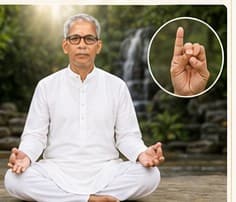
A soft, enclosed fist — the thumb tucked in and the fingers folded gently over it, the same shape the body finds on its own in deep rest. Guruji gives this to students who run hot, sleep badly, or need to come down from an agitated day rather than go further up.
Yoni Mudra
योनि मुद्रा
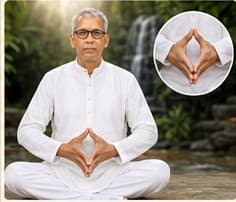
A seated, two-handed mudra practised with the eyes closed, turning attention inward toward mūlādhāra, the root centre. Guruji lists it among the mudras that steady the emotions and support creative work, alongside its long history as a meditation seal in its own right.
4 practices
Subtle Mudras
Seals made with the eyes, tongue, breath and pelvic floor rather than the hands. Documented here for understanding — three of the four need a teacher present.
शाम्भवी मुद्रा
Śāmbhavī Mudrā
Shambhavi Mudra
शाम्भवी मुद्रा
The eyebrow-centre gaze. Both eyes turn upward and inward toward ājñā chakra while the face stays entirely relaxed. One of the most powerful concentration practices in yoga, and one of the easiest to overdo.
नासिकाग्र दृष्टि
Nāsikāgra Dṛṣṭi
Nasikagra Drishti
नासिकाग्र दृष्टि
The eyes are directed downward and inward to the tip of the nose. Gentler than Shambhavi and better suited to beginners, it is the gaze Krishna specifies in the Bhagavad Gita for the seated practitioner.
अश्विनी मुद्रा
Aśvinī Mudrā
Ashwini Mudra
अश्विनी मुद्रा
Rhythmic contraction and release of the anal sphincter. Unglamorous, invisible, and among the most useful practices in the whole system — it is the pelvic floor training that modern physiotherapy arrived at independently, several centuries later.
महा मुद्रा
Mahā Mudrā
Maha Mudra
महा मुद्रा
A seated forward fold over one extended leg with the heel of the other pressing the perineum, held with retained breath and the three bandhas engaged. The most complete single practice in Hatha Yoga, and one that genuinely requires a teacher.
"Do not force any mudra. Let the finger arrive on its own. A seal is not a grip — it is a resting place."
Guruji K. S. N. Murthy